
BirdEye SEM Case Study With 43% Lower Cost per Lead
A summary of my reported work directing global SEM, testing ads, refining queries and evaluating acquisition performance for a B2B SaaS company.
- Global SEM program scope of $6.4M
- Bidding, ad testing and query optimization
- Reported program-level acquisition outcomes
One global SEM program
The historical figures below summarize the results already published in my career case-study collection.
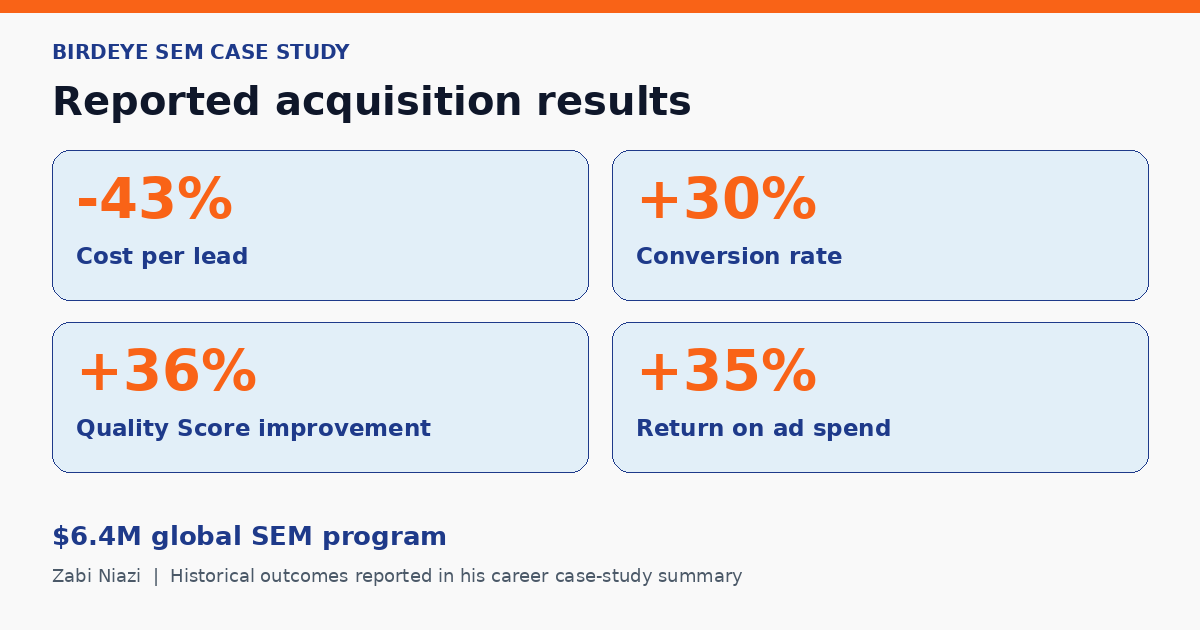
- 43% lower cost per lead
- 30% higher conversion rate
- 36% Quality Score improvement
- 35% higher ROAS
Published · By Zabi Niazi
On this page
BirdEye SEM work at a glance
This case study summarizes my published global SEM work at BirdEye, a B2B SaaS company in Palo Alto. The account scope was a $6.4M SEM program, with reported outcomes of 43% lower cost per lead, 30% higher conversion rate, 36% improvement in Quality Score and 35% higher ROAS.
The business challenge was to reduce acquisition cost while growing conversions across global search activity. My role covered SEM direction, bidding, responsive ad testing, query optimization and multi-touch attribution.
The acquisition challenge
Reducing lead cost while growing conversions requires a useful definition of success. Lower-cost traffic can change the mix of inquiries, while campaign changes can affect different stages of the buying journey.
The published challenge for the BirdEye program was to cut acquisition cost while growing conversions worldwide. The account required coordinated work across search intent, advertising and measurement.
For a B2B SaaS team evaluating a similar problem, the important starting questions are which leads are valuable, how they are measured and where campaign decisions can improve the full journey.
The work covered
Global SEM direction
I directed the SEM program around the acquisition objective and its measurement. The published scope describes a $6.4M program without assigning a monthly or annual period.
Bidding
The work included advanced bidding. Bid decisions need to be evaluated alongside the conversion signals and the quality of the traffic they attract.
Responsive ad testing
I tested responsive ads as part of the SEM work. The relevant question is how the message and offer help the right buyer take the next step.
Query optimization
The published approach included natural-language query optimization. Search-query interpretation helps distinguish the buyer’s need from the surface wording of a keyword.
Attribution
Multi-touch attribution was part of the approach. It provides context for evaluating a buying journey that can include multiple interactions before conversion.
Combined evaluation
The results below summarize the program’s reported outcomes. They are presented at program level; each workstream needs evidence before its individual contribution can be quantified.
Reported results
| Metric | Reported change | How to interpret it |
|---|---|---|
| Cost per lead | 43% lower | Evaluate the lead definition and qualification mix alongside acquisition cost. |
| Conversion rate | 30% higher | Compare like-for-like definitions and traffic segments when reviewing changes. |
| Quality Score | 36% improvement | This is the reported change, rather than a 36-point score. Review the underlying keyword-level components when diagnosing an account. |
| Return on ad spend | 35% higher | Interpret the metric with the program’s revenue attribution and measurement definitions. |
| Program budget | $6.4M | The published scope describes the managed SEM program without specifying a budget period. |
These are historical career results, not a forecast for another account. Performance comparisons require consistent definitions, periods and attribution methods.
What a B2B team can apply
- Define the business outcome before changing campaign settings.
- Review query intent, ads and the landing-page offer together.
- Use measurement that lets the team judge the quality of acquired leads.
- Evaluate proposed changes with enough evidence and a documented validation plan.
- Keep the account owner, sales team and measurement owner aligned on the same definitions.
If your team needs to identify the next account changes, a Google Ads audit provides a structured starting point. If the lead-to-CRM handoff is the main uncertainty, start with conversion tracking consulting.
How this case study is presented
The figures and workstreams here come from my published career case-study summary. They describe my reported work at BirdEye. The presentation uses no client account credentials or customer-level data.
For a prospective engagement, we can discuss which parts of this experience are relevant to your account, the measurement definitions you use and the evidence needed to evaluate your own results.
You can also review the full case-study collection and my professional experience.
About the author
Zabi Niazi is a San Francisco Bay Area digital marketing consultant with 16+ years in B2B SaaS and enterprise search marketing. His published work includes global SEM at BirdEye and marketing programs at Qualys. Read about Zabi, view his resume, or explore the case studies.
Discuss the acquisition problem your team is facing
Share your current objective, the account scope and the result your team needs to measure.
Book a free consultationView all case studies